E-line LED Trunking System: The Complete Guide for Warehouse and Industrial Lighting
If you're running a warehouse, a logistics hub, or a large-scale production floor, you already know the pain of bad lighting. Fixtures that wash everything in a dull yellow glow. Systems that take forever to wire. Lamps that burn out every 18 months and require a platform truck just to swap.
The E-line LED trunking system from Recolux was built specifically to solve all three of those problems. Here's everything you need to know before you spec it into your next project.
What Is a Trunking System?
A trunking system is a continuous rail-based lighting solution. Instead of wiring individual fixtures to separate circuit outlets, you snap them into a live rail. The rail carries the power and the data signal. The fixtures clip in anywhere along that rail.
That means you can rearrange, add, or remove lighting points without touching conduit or calling an electrician. For racking-heavy warehouses where the shelf layout changes seasonally, that flexibility is worth a lot.
The E-line System: 20 Optical Configurations
What separates the Recolux E-line from cheaper trunking products is the optical precision. The system ships with 20 distinct optical combinations. You choose beam angle and beam shape based on the specific task at hand.
Narrow asymmetric optics push light sideways along an aisle without blinding pickers walking the rows. Wide symmetric distributions flood a packing area evenly. Deep-penetration narrow beams can reach 12-meter rack faces without creating hot spots at ground level.
Most facilities need at least three or four configurations across different zones. The E-line handles this from a single product family, which simplifies procurement and inventory.
Color Rendering: Ra > 90
The E-line carries a color rendering index above 90. In plain English, colors look accurate under this light.
Why does that matter in an industrial setting? Damaged goods inspection is the clearest example. A conveyor line screening products for discoloration or bruising needs accurate color information. Under low-CRI lighting, subtle color differences disappear. You miss defects. Returns go up.
Picking accuracy also improves. Color-coded storage systems, bin labels, and barcode stickers all read faster when the light renders them accurately. Minor point, but across a thousand picks per shift, it adds up.
Glare Control
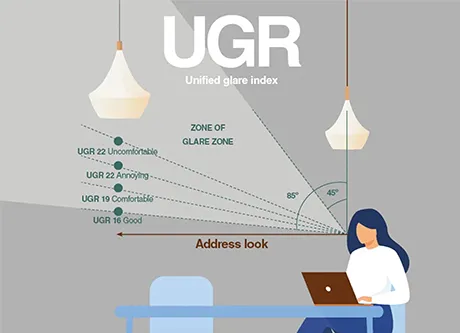
High-bay and trunking installations are notoriously glare-prone because the luminaires sit directly above eye-level work areas. Workers looking up to read rack numbers or verify bin locations get hit by raw lamp glare.
The E-line uses precision optical housings that cut the luminous intensity at high angles. The result is a Unified Glare Rating that keeps the space comfortable for extended work without the eye fatigue that shows up by the afternoon shift.
Where E-line Gets Installed
The system is rated for warehouses, manufacturing floors, logistics centers, commercial retail interiors, and large open-plan offices. The IP rating handles light dust and condensation typical of unheated or semi-heated logistics buildings.
Projects that spec E-line typically see installation time cut roughly in half compared to conventional fixtures. The rail mounts first, everything else snaps in. Maintenance follows the same logic, replace a driver or LED module without dismounting the housing.
Comparing Energy Numbers
A conventional T8 fluorescent trunking installation in a 5,000 square meter warehouse might run 150 to 180 watts per fixture. Modern LED replacements in the same form factor typically land at 40 to 60 watts, depending on mounting height and target illuminance.
E-line units hit 40W to 80W depending on configuration, with luminous efficacy in the range of 130–150 lm/W. At 50,000 rated hours, the maintenance cycle extends roughly four to five times beyond what you'd see with fluorescent sources.
Controls Integration
The E-line connects to standard DALI and 0-10V dimming systems. For automated warehouses with variable occupancy, this matters. Zones with no activity dim to 20–30% automatically. Zones with active pickers or forklifts bring up to full output.
Sensor integration handles both motion and daylight harvesting. Facilities near perimeter windows can let natural light carry some of the load during daytime hours, trimming energy consumption further.
Practical Specification Notes
When quoting an E-line project, a few things are worth confirming early.
Mounting height drives optic selection. Below 6 meters, wide distributions work fine. Above 8 meters, you need narrow or medium-narrow optics to put enough light on the floor without oversizing the wattage.
Aisle width affects the asymmetric vs. symmetric decision. Narrow aisles under 2.5 meters benefit from asymmetric units mounted on the center rail. Wider aisles work better with symmetric units at regular spacings.
Rack height relative to fixture height determines whether you need separate task lighting at lower levels. In VNA (very narrow aisle) racking above 10 meters, supplemental aisle lighting is often added regardless of the top-level trunking spec.
Why Recolux Manufactures This In-House
Recolux controls the full production chain for the E-line: LED modules, drivers, optical components, and housing extrusions. That's relevant for a few reasons.
Lead times are predictable because the supply chain isn't dependent on third-party component suppliers with their own backlogs. Custom configurations, different CCT for different zones for instance, don't require a minimum order that only makes sense for a 50,000-fixture rollout.
Third-party testing against IEC and CE standards is standard procedure. The documentation comes with the product, which matters when you're commissioning a facility that needs to pass building inspections or insurance audits.
The Bottom Line
The E-line trunking system is a well-engineered solution for high-demand industrial and commercial spaces. The optical flexibility covers most real-world installation scenarios. The Ra > 90 rendering addresses quality-critical applications. Controls integration fits modern building management expectations.
If you're replacing aging fluorescent trunking or planning a new facility, it's worth requesting a photometric layout from the Recolux team before committing to a specification. The 20 optical configurations mean a layout optimized for your specific racking pattern will look different from a generic spec sheet, and the energy numbers will be more accurate.