LED Trunking System: The Complete Guide to Continuous Line Lighting (2026)
Industrial & Commercial Lighting Guide
LED Trunking System: The Complete Guide to Continuous Line LightingEverything facility managers, electrical specifiers, and procurement teams need to know about LED trunking systems in 2026—from specifications and ROI to smart controls and future trends.
When a warehouse manager stands under a grid of 40 high bay lights casting harsh overlapping circles on the floor, and a production line supervisor across town walks through aisles bathed in uniform, shadow-free illumination, the difference isn't the wattage. It's the lighting topology. LED trunking systems—continuous linear lighting mounted on trunking rails—solve the problem that point-source high bays were never designed to address: consistent, seamless coverage across long spaces.
1. What Is an LED Trunking System?
An LED trunking system is a linear lighting solution where multiple LED modules are mounted on a continuous trunking rail—a metal channel that serves as both the physical support structure and the electrical conduit. Unlike individual high bay fixtures spaced every few meters, trunking systems create an uninterrupted line of light that can run the entire length of a facility.
Core Components
| Component | Function | What to Look For |
|---|---|---|
| Trunking rail | Structural backbone + electrical pathway | Galvanized steel or aluminum; pre-wired with 5- or 7-core internal cabling |
| LED modules | Light-emitting units that clip/snap onto the rail | Modular, hot-swappable; available in multiple lumen packages and beam angles |
| End caps & connectors | Terminate and join rail sections | Tool-free mechanical connectors; L, T, and cross junction options |
| Power supply/driver | Converts mains AC to LED-compatible DC | Integral or remote; DALI-2 or 0-10V dimming compatibility |
| Mounting hardware | Suspension or surface-mount brackets | Adjustable cable suspensions for varying ceiling heights |
Key architectural difference: High bays concentrate lumens in a single point; trunking systems spread them evenly along a line, dramatically reducing the bright-spot/dark-zone pattern that plagues point-source layouts.
2. Trunking System vs. Traditional High Bay
This is the question specifiers ask most often—and the answer depends on four factors.
Comparison Matrix
| Criterion | LED Trunking System | Traditional High Bay |
|---|---|---|
| Light uniformity | Excellent—continuous illumination, minimal shadowing | Moderate—overlapping cones create bright spots and dark zones |
| Best for space profile | Long, narrow spaces: aisles, production lines, rack rows | Open, square spaces: bulk storage, gymnasiums, atriums |
| Installation complexity | Lower per-linear-meter—snap-in modules, pre-wired rails | Higher per-fixture—each unit needs independent mounting and wiring |
| Scalability | High—add/remove/reposition modules without rewiring | Low—adding fixtures means new mounting points and electrical runs |
| Aesthetic quality | Clean, architectural appearance, suitable for customer-facing spaces | Utilitarian industrial look |
| Maintenance access | Module-level replacement without touching the rail or wiring | Full fixture replacement needed for most failures |
| Upfront cost (per meter) | Moderate to high | Low to moderate |
| Total cost of ownership | Lower—longer system life, easier maintenance, better energy distribution | Higher—more replacement labor, uneven aging pattern |
The Decision Framework
✓ Choose Trunking When
Space is longer than it is wide (production lines, warehouse aisles, supermarket aisles)
Uniform illumination is critical for safety or quality control
You anticipate layout changes over the system's lifetime
Customer-facing areas where appearance matters
Difficult maintenance access (module-swap approach pays for itself in labor savings)
○ Choose High Bays When
Space is roughly square with high ceilings (sports halls, bulk storage)
Budget constraints are the primary driver
Mounting heights exceed 15 meters (point-source optics handle extreme heights better)
Simple lighting layout unlikely to change
Both can coexist: Many large facilities use trunking systems over aisles and workstations, high bays over open storage areas. It's not an either/or decision for most industrial sites.
3. Technical Specifications That Actually Determine Performance
Lighting spec sheets are full of numbers. Here are the ones that separate a system that performs for a decade from one that causes headaches in year two.
3.1 Color Rendering Index (CRI/Ra)
CRI measures how accurately a light source reveals colors compared to natural daylight. For industrial and commercial applications, CRI is not a luxury metric—it directly affects quality inspection accuracy, worker safety, retail sales, and reading comfort.
Ra > 90: Colors appear nearly as under daylight.
Ra > 80: Adequate for basic warehousing.
Ra > 90: Standard for spaces where visual accuracy has economic consequences.
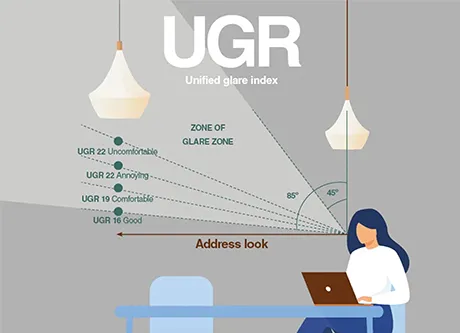
3.2 Glare Control (UGR)
Unified Glare Rating quantifies discomfort from bright light sources in the field of view. In industrial environments with medium-height mounting (3–8 meters), glare is the most common yet most overlooked lighting complaint.
The best trunking systems achieve low UGR through optical design—microprismatic diffusers, recessed LED positions, and precisely engineered reflectors.
< 19 Offices & precision work
< 22 Most industrial tasks
< 25 Basic warehouse ops
> 25 Uncomfortable—complaints
3.3 Ingress Protection (IP Rating)
| IP Rating | Protection Level | Suitable Environments |
|---|---|---|
| IP20 | Protected from solid objects >12.5mm | Clean indoor spaces only |
| IP44 | Splash-proof from any direction | Standard indoor industrial; covered outdoor |
| IP54 | Dust-protected + splash-proof | Dusty warehouses, workshops, under canopies |
| IP65 | Dust-tight + water jet resistant | Wash-down areas, food processing, outdoor |
| IP69K | Dust-tight + high-pressure/steam cleaning | Dairy, meat processing, car washes |
For most indoor industrial applications, IP54 is the practical sweet spot—adequate dust protection without the cost premium of fully sealed IP65+ fixtures.
3.4 Optical System Flexibility
This is where premium trunking systems differentiate themselves. A high-quality system offers multiple beam angle options from the same physical module:
Narrow beam (15–30°): High mounting heights, concentrated task lighting
Medium beam (60–90°): General industrial illumination at 4–8m heights
Wide beam (100–120°): Low mounting heights, broad coverage, reduced shadowing
Asymmetric beam: Aisle-specific distribution—throws light forward and down, not into the adjacent rack
Systems that combine 10–20 optical variants within a single platform allow one trunking rail to serve multiple lighting tasks within the same facility.
4. Installation Efficiency: The Hidden Cost Driver
Installation labor is the single largest variable cost in industrial lighting projects. LED trunking systems reduce this cost through modular, tool-free assembly.
What 43-Second Module Installation Means for Your Project
When trunking modules use clip-in or snap-lock mechanisms, individual units can be installed in under 60 seconds.
| Installation Activity | High Bay (per fixture) | Trunking Module (per module) |
|---|---|---|
| Mount fixture/rail | 8–12 minutes | Rail: 15 min per 3m section (shared across 6–8 modules) |
| Electrical connection | 5–8 minutes per fixture | Pre-wired rail—zero per-module wiring |
| Alignment/leveling | 3–5 minutes per fixture | Rail-level adjustment; modules self-align |
| Total per light point | 15–25 minutes | 2–4 minutes (amortized) |
25–42h
High Bay Installation
100 light points
7–11h
Trunking Installation
100 light points
3:1 to 4:1 labor ratio that single-handedly justifies the higher material cost of trunking systems in many projects.
Through-Wiring Advantage
Trunking rails with pre-installed through-wiring eliminate the most time-consuming part of installation: running individual electrical drops to each fixture. The rail carries power end-to-end. Modules tap into it at any position. If the layout changes, modules slide along the rail without an electrician.
5. Smart Controls: The Trunking System's Natural Advantage
Continuous rail infrastructure creates opportunities for control systems that distributed high bays can't match cost-effectively.
Integrated Sensor Networks
Because trunking modules share a common rail and power bus, integrating sensors becomes modular rather than per-fixture:
Daylight harvesting: Modules near windows or skylights dim automatically when natural light is sufficient. Modules in interior zones maintain full output. The system adjusts per-module, not per-circuit.
Occupancy-based zoning: PIR or microwave sensors in select modules control groups of adjacent modules. Aisle-by-aisle control without per-fixture sensor costs.
Scene programming: Production shifts, cleaning crews, and security patrols each trigger different lighting profiles—bright for production, reduced for cleaning, minimal for security.
DALI-2 Integration
DALI-2 (Digital Addressable Lighting Interface) allows each module to be individually addressed and controlled. This means:
Individual module dimming (0–100%) without affecting neighbors
Real-time energy monitoring at module level
Automated fault reporting—a failed driver reports itself to the building management system
Integration with broader Building Management Systems (BMS) via BACnet or Modbus gateways
For facilities pursuing ISO 50001 energy management certification, module-level energy data from DALI-enabled trunking systems provides the granularity auditors look for.
6. Application Scenarios Where Trunking Systems Excel
► Production Lines & Assembly
Continuous light eliminates the stroboscopic flicker effect that point-source lights create when moving machinery passes under alternating bright and dim zones. In manufacturing environments with rotating equipment, stroboscopic effects can make moving parts appear stationary—a serious safety hazard.
Asymmetric beam distribution for work surfaces
High CRI (Ra > 90) for quality inspection
Module-level dimming for automated vs. manual zones
► Warehouse & Logistics
Aisle lighting is the textbook application for trunking systems. The continuous line matches the spatial geometry of rack rows.
Uniform vertical illumination—top and bottom shelves receive similar light
Reduced forklift glare compared to point-source high bays
Emergency battery backup integrated into select modules
► Supermarkets & Retail
Retail is the fastest-growing application. The clean, continuous line creates a premium ceiling aesthetic while delivering:
Ra > 90 color rendering for produce, meat, and packaged goods
DALI dimming that adjusts ambient light throughout the day
Track spotlight modules on the same rail for accent lighting
► Automotive Workshops & Service Centers
Vehicle service bays present unique lighting challenges: technicians work at odd angles, under vehicles, and in engine compartments where shadows hide problems.
Wide-beam optics minimize shadows under raised vehicles
High IP ratings (IP54+) for water spray and workshop dust
Professional, modern workshop image
► Food Processing & Cold Storage
When IP69K-rated tubular modules are mounted on trunking rails, food processing facilities get:
Washdown-ready fixtures that survive high-pressure cleaning
Condensation resistance—sealed rails prevent moisture ingress
Color-accurate lighting for visual quality inspection
Recolux case studies show supermarkets achieving 70% energy savings compared to legacy fluorescent systems while simultaneously improving food presentation quality—an outcome that satisfies both the CFO and the merchandising director.
7. ROI Analysis: Making the Financial Case
Sample Calculation: 80-Meter Production Line Retrofit
Existing system: 20 × 250W metal halide high bays, spaced every 4 meters
Proposed system: 80 linear meters of LED trunking with 40 LED modules (one every 2 meters, 60W each)
| Cost/Savings Category | Existing (Annual) | LED Trunking (Annual) |
|---|---|---|
| Energy consumption | 20 × 250W × 4,000h = 20,000 kWh | 40 × 60W × 4,000h = 9,600 kWh |
| Energy cost (@ $0.12/kWh) | $2,400 | $1,152 |
| Lamp replacement | 8 lamps/year @ $45 = $360 | 0 |
| Maintenance labor | 12 hours @ $75/hr = $900 | 2 hours @ $75/hr = $150 |
| Total annual OpEx | $3,660 | $1,302 |
ROI Summary
$2,358
Annual Savings
5–7 yr
Simple Payback
$11.5–15.5K
10-Year Net Savings
52%
Energy Reduction
This calculation excludes utility rebates (which can reduce upfront costs by 15–30%) and productivity improvements from better lighting—which are real but harder to quantify.
8. How to Specify: A Procurement Checklist
When evaluating trunking systems from different manufacturers, use this checklist to compare like with like:
System-Level Requirements
Rail material: Galvanized steel or aluminum? Aluminum is lighter but steel is more rigid for long spans.
Rail cross-section: Does it accommodate the required number of internal conductors (5-core minimum for DALI; 7-core for emergency circuits)?
Mechanical connector type: Tool-free? Can rails be joined after modules are installed?
Maximum suspension spacing: How many support points per 3-meter rail section? (Fewer = faster installation)
Module-Level Requirements
Lumen output options: Range from at least 2,000 lm to 8,000+ lm per module
Available CCT: 3000K, 4000K, 5000K minimum; tunable white (2700–6500K) if circadian or retail applications
CRI: Ra > 80 minimum; Ra > 90 for quality-critical spaces
Beam angle options: At least 3 (narrow, medium, wide); asymmetric option for aisle applications
Module dimensions: Standardized lengths (600mm, 1200mm, 1500mm) for layout flexibility
Module weight: Lighter modules = faster installation, less structural load
Control Requirements
Dimming protocol: 0-10V, DALI-2, or both
Sensor compatibility: Can PIR/daylight sensors be integrated into the module or rail?
Emergency options: Self-contained battery modules available? 3-hour runtime minimum per EN 60598-2-22
Compliance & Warranty
Certifications: CE, UKCA, or relevant regional marks; photobiological safety (IEC 62471)
System warranty: 5-year minimum; 7–10 years for premium systems
Lumen maintenance: L70 > 50,000 hours; L80 > 50,000 hours for premium systems
Driver warranty: Separate or included in system warranty?
9. Common Misconceptions About Trunking Systems
Myth
"Trunking systems are only for new builds."
False. Most trunking systems support retrofit installation. Existing high bay mounting points can often be reused. Recolux case studies in German workshops demonstrate this—old T8 fluorescent trunking was repurposed as a mounting rail for new LED modules, halving the installation cost.
Partially True
"Trunking systems are more expensive than high bays."
True for materials; false for total cost. When installation labor, maintenance access, energy distribution efficiency, and system lifespan are all factored in, trunking systems typically achieve lower TCO over 5+ years in the applications they're designed for.
Myth
"All trunking systems are the same—just compare wattage and price."
The difference between a $60/meter system and a $120/meter system is in the optical design, glare control, color consistency, and driver quality. These differences compound over 50,000 hours of operation. A system with poor glare control creates user complaints that lead to early replacement. A system with poor color consistency creates a patchwork ceiling appearance that undermines the architectural benefit.
Myth
"You can't mix module types on the same rail."
In well-designed systems, you can. A production line might use high-output wide-beam modules over assembly stations, narrow-beam modules over inspection points, and standard modules over walkways—all on the same continuous rail, drawing from the same power bus.
10. Frequently Asked Questions
What's the minimum ceiling height for a trunking system?
Trunking systems work at any height, but below 2.8 meters, glare control becomes critical. Use wide-beam optics (100°+) and low-glare diffusers for low ceilings. Above 8 meters, consider supplementing with high bays for the center of wide spaces.
Can trunking systems be installed outdoors?
Yes, with appropriate IP ratings. IP65-rated modules on weatherproof rails can be installed under canopies, in loading bays, and in open-sided structures. For fully exposed outdoor installation, verify UV stability of polycarbonate components and corrosion resistance of metal parts.
How do I handle emergency lighting requirements with a trunking system?
Most manufacturers offer modules with integrated 3-hour emergency battery packs. These can be distributed every 5–10 meters along the rail. In DALI systems, the emergency modules report their battery health to the central controller.
What happens if one module fails? Does it take down the whole rail?
No. In a properly designed trunking system, modules are electrically independent. A failed module does not affect its neighbors. Replacement is a tool-free swap in most systems—unclip the dead module, clip in the replacement.
Are trunking systems compatible with existing lighting control systems?
Most are. DALI-2 trunking systems integrate with standard DALI controllers, gateways, and BMS platforms. 0-10V systems work with most legacy dimming controls. Check the driver specification for protocol compatibility before ordering.
11. The Future of Trunking Lighting: 2026 and Beyond
Three trends are reshaping LED trunking systems:
Human-Centric Lighting (HCL)
Tunable-white trunking systems that shift from cool 5000K during production shifts to warm 2700K during cleaning hours are moving from research papers into factory floors. The continuous rail format is ideal for HCL because the color shift is spatially uniform—no patchwork of different CCT fixtures.
PoE (Power over Ethernet) Lighting
Trunking rails carrying low-voltage DC power alongside data cables enable PoE lighting—each module becomes a network node. This converges lighting, sensors, and IoT into a single infrastructure. Early adopters in logistics are using PoE trunking to run real-time location systems (RTLS) for asset tracking alongside the lighting.
Sustainability-Driven Retrofits
As ESG reporting mandates tighten, the carbon-reduction arithmetic of lighting retrofits gets simpler. A trunking system that cuts lighting energy by 60% compared to legacy fluorescent is a directly reportable Scope 2 emissions reduction. The modular design also means failed modules are recyclable electronic waste rather than entire fixture replacements.
Conclusion: Is an LED Trunking System Right for Your Facility?
LED trunking systems are not a universal solution, but for the applications they suit—production lines, warehouse aisles, supermarkets, workshops, and any long, narrow space where light uniformity and installation efficiency matter—they represent the best available lighting topology in 2026.
The decision process is straightforward:
Assess your space geometry: Long and narrow? Trunking. Open and square? High bays may suffice.
Calculate total cost, not upfront cost: Include installation labor, maintenance access, and system lifespan.
Evaluate light quality requirements: If CRI, glare control, or uniformity specifications are tight, trunking's optical advantages become decisive.
Consider future flexibility: If your layout might change, trunking's reconfigurability protects your investment.
For facility managers who want to see how an LED trunking system would perform in their specific space, most manufacturers—including Recolux—provide photometric layouts (DIALux or Relux simulations) as part of the specification process. These simulations show illuminance levels, uniformity ratios, and glare ratings before a single fixture is ordered.