Warehouse & Logistics Center LED Lighting: The Complete Guide to Efficient Illumination (2025)
.my-class {font-size: 12px;}
Warehouses are no longer dark, dusty spaces where a few fluorescent tubes are enough. Modern logistics centers operate 24/7, with forklifts navigating narrow aisles at speed, pickers scanning barcodes at 200 picks per hour, and automated guided vehicles (AGVs) relying on consistent illumination for navigation. The lighting in these facilities directly affects picking accuracy, workplace safety, energy consumption, and operational throughput.
Yet warehouse lighting is often treated as an afterthought — specified from outdated lux tables designed for static storage, not dynamic logistics. A warehouse lit to 150 lux with uneven distribution might meet the minimum standard on paper. In practice, it creates shadowed rack faces that slow pickers by 15–20%, glare zones that obscure forklift operators' sightlines, and dark corners where inventory errors accumulate unnoticed.
This guide covers every major decision point when specifying LED lighting for warehouses and logistics centers — from the trunking-vs-high-bay tradeoff to zone-specific lux requirements, smart control strategies, and the ROI model that justifies the investment.
1. Why Warehouse Lighting Is a Distinct Design Challenge
Warehouse lighting sits at the intersection of three conflicting demands that office or retail lighting never faces:
High mounting heights with narrow access: Fixtures are installed 6 to 15 meters above the floor. Relamping a failed fixture requires a scissor lift, shutting down an aisle, and coordinating with warehouse operations — a 2-hour disruption for a 10-minute job.
Vertical surfaces matter more than horizontal: In a warehouse, the critical visual task is reading labels and barcodes on vertical rack faces — not seeing the floor. Standard horizontal illuminance measurements (lux at floor level) tell you almost nothing about whether a picker can read a label on shelf level 4.
Rapidly changing layouts: Unlike a factory with fixed production lines, warehouse racking configurations change as inventory profiles shift. Lighting that works for wide-aisle pallet storage may be completely wrong for narrow-aisle piece-picking six months later.
These three factors mean that a standard industrial high bay fixture — perfectly adequate for a manufacturing plant — will underperform in a modern warehouse unless the entire lighting design is approached from first principles.
The key differences between traditional warehouse lighting assumptions and modern logistics requirements are summarized below:
| Design Parameter | Traditional Warehouse (Pre-2010) | Modern Logistics Center (2025) |
|---|---|---|
| Operating hours | 8–12 hours/day, single shift | 24/7 multi-shift operation |
| Primary visual task | Navigating aisles, identifying pallet locations | Barcode scanning, label reading on vertical rack faces, AGV navigation |
| Critical measurement | Horizontal illuminance (lux at floor) | Vertical illuminance at rack face (lux at 0.5m–6m height) |
| Uniformity requirement | U₀ ≥ 0.25 (large tolerated variation) | U₀ ≥ 0.4 (min/avg); U₀ ≥ 0.6 for picking zones |
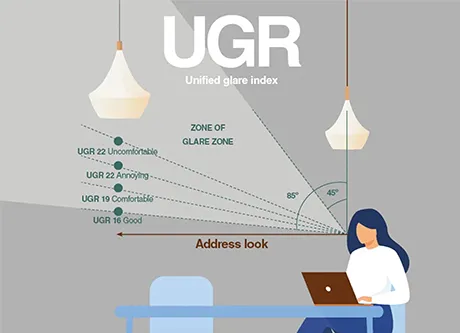
| Glare control | Not considered | UGR ≤ 25 for occupied aisles; ≤ 22 for picking stations |
| Controls | Manual on/off per circuit | Occupancy sensing, daylight harvesting, DALI zoning, aisle-by-aisle dimming |
| Fixture lifespan requirement | 15,000–20,000 hours (fluorescent/metal halide) | ≥ 50,000 hours L70 (LED) — minimal maintenance access |
2. Trunking Systems vs. High Bay Fixtures: Choosing the Right Form Factor
The single most important architectural decision in warehouse lighting design is the choice between continuous-line trunking systems and discrete high bay fixtures. Each has a fundamentally different light distribution pattern and suits different warehouse typologies.
2.1 Continuous-Line LED Trunking Systems
Trunking systems mount LED modules in a continuous linear run — typically 20 to 80 meters long — suspended from the ceiling or mounted directly to structural beams. They produce a uniform, shadow-free light sheet that eliminates the dark spots between individual fixtures.
This is critical in racked warehouses, where the vertical face of shelving units must be evenly illuminated from top to bottom. A trunking run installed directly above an aisle delivers consistent vertical illuminance regardless of the picker's position along the aisle — there is no "gap" between fixtures where light levels drop.
Advantages of trunking for warehouses:
Exceptional uniformity: No peaks and troughs between fixtures. Uniformity ratios of 0.7–0.85 are achievable in aisles, versus 0.4–0.6 with spaced high bays.
Simplified installation: One continuous electrical run per aisle versus individual drops for each high bay. Fewer connection points mean fewer potential failure points.
Flexible reconfiguration: Trunking runs can be extended, shortened, or repositioned as racking layouts change. Individual LED modules can be swapped or upgraded without replacing the entire system.
Optical versatility: Advanced trunking systems — such as Recolux's E-line with 20 optical distributions — allow different beam angles to be mixed within the same run. Wide-beam modules for general aisle illumination can be combined with narrow-beam modules for deep-rack penetration.
2.2 Discrete LED High Bay Fixtures
High bay fixtures — typically round UFO-style or rectangular linear high bays — are spaced at regular intervals (often 4–8 meters apart depending on mounting height). Each fixture produces a conical or rectangular light distribution that overlaps with adjacent fixtures to achieve the target uniformity.
Where high bays outperform trunking:
Very high ceilings (≥ 12m): At extreme mounting heights, the wide distribution of trunking systems loses intensity. High-output high bays with focused optics can punch light down to the floor from 15m+ more efficiently.
Open-floor warehouses without racking: Bulk storage facilities where pallets are stacked directly on the floor do not require vertical illuminance on rack faces. High bays provide efficient general illumination at lower fixture counts.
Lower upfront cost per fixture: A 150W LED high bay is typically 20–30% cheaper per unit than an equivalent-length trunking module. For budget-constrained projects with simple lighting requirements, this matters.
2.3 Decision Matrix: Trunking vs. High Bay by Warehouse Type
| Warehouse Type | Recommended System | Rationale |
|---|---|---|
| Narrow-aisle racked warehouse (VNA, < 2m aisle width) | Trunking system | Aisle-mounted continuous line delivers uniform vertical illuminance; high bays create dark spots between fixtures |
| Wide-aisle pallet racking (3–4m aisle width) | Trunking system (preferred) or spaced linear high bays | Both can work; trunking provides better uniformity at rack face |
| Bulk floor storage (no racking) | High bay fixtures | General horizontal illuminance is sufficient; lower cost per square meter |
| Cross-dock / transshipment center | Trunking system | Continuous operation with rapidly changing layouts; trunking reconfigures easily |
| Automated storage & retrieval (AS/RS) | Integrated trunking | Lighting integrated into rack structure; no human occupancy in aisles during operation |
| Cold storage / freezer warehouse | Tri-proof trunking or tubular | Requires IP65+ sealing and cold-rated drivers; standard high bays fail within 2 years |
| E-commerce fulfillment center | Trunking system with smart controls | Combination of picking stations (high CRI), conveyors (uniform), and packing (glare-controlled) |
Key insight: If your warehouse has racking and your pickers read labels at height — choose trunking. If your warehouse stores pallets on the floor and your forklift drivers only need to see the pallet location — high bays are sufficient. The entire decision hinges on whether the visual task is on a vertical surface or a horizontal surface.
3. Zone-by-Zone Lux Requirements for Warehouses
Applying a single lux target to an entire warehouse is the most common lighting design error — and the most expensive in terms of operational impact. Different zones within the same facility have fundamentally different visual tasks, and lighting specifications must reflect this.
The table below provides recommended illuminance levels synthesized from EN 12464-1 (European standard for indoor workplace lighting), IESNA RP-7 (American practice for industrial lighting), and operational experience from logistics facilities.
| Warehouse Zone | Recommended Lux (Working Plane) | U₀ (Uniformity Min/Avg) | UGR (Glare Limit) | CRI (Ra) | Measurement Height |
|---|---|---|---|---|---|
| Loading docks (indoor) | 200–300 | ≥ 0.4 | ≤ 25 | ≥ 70 | Floor level |
| Loading docks (outdoor/canopy) | 100–150 | ≥ 0.3 | ≤ 28 | ≥ 70 | Floor level |
| Bulk storage (floor-stacked, no racking) | 150–200 | ≥ 0.25 | ≤ 28 | ≥ 70 | Floor level |
| Racked storage — low bay (< 6m rack height) | 200–300 (horizontal) 150–200 (vertical at rack face) | ≥ 0.4 | ≤ 25 | ≥ 80 | Floor + rack face at 0.5–6m |
| Racked storage — high bay (> 6m rack height) | 250–350 (horizontal) 200–250 (vertical at rack face) | ≥ 0.5 | ≤ 22 | ≥ 80 | Floor + rack face at 1m–12m |
| Picking zones (manual piece-pick) | 300–500 | ≥ 0.6 | ≤ 22 | ≥ 85 | Rack face at pick height |
| Packing stations / dispatch | 500–750 | ≥ 0.6 | ≤ 19 | ≥ 85 | Task surface (0.85m) |
| Conveyor / sortation areas | 300–400 | ≥ 0.5 | ≤ 25 | ≥ 80 | Conveyor surface |
| QC / inspection stations | ≥ 750 | ≥ 0.7 | ≤ 19 | ≥ 90 | Task surface |
| Cold storage / freezer (−20°C to −30°C) | 150–200 | ≥ 0.4 | ≤ 25 | ≥ 80 | Floor + rack face |
| Office / administration areas | 500 | ≥ 0.6 | ≤ 19 | ≥ 80 | Desk surface (0.75m) |
| Corridors, stairwells, amenity areas | 100–150 | ≥ 0.4 | ≤ 25 | ≥ 70 | Floor level |
Critical measurement principle: In racked warehouses, horizontal lux at floor level is a secondary metric. The primary metric is vertical illuminance at the rack face — measured at each shelf level that pickers access. A warehouse that measures 300 lux at floor level can still have shelf level 4 at 50 lux if the lighting distribution is too narrow or the fixtures are spaced incorrectly. Always verify the photometric plan at the rack face, not just at floor level.
4. Color Temperature and CRI: What Warehouse Tasks Actually Need
The dominant color temperature in warehouse lighting has shifted dramatically over the past decade — and for good reasons grounded in visual science, not trends.
4.1 4000K–5000K: The Warehouse Standard
Almost all modern warehouse specifications call for 4000K (neutral white) or 5000K (cool white). The reasons are physiological:
Scotopic/photopic (S/P) ratio: Cool white light (higher color temperature) stimulates rod cells (scotopic vision) more effectively than warm white. Under mesopic conditions — the intermediate light level typical of warehouses, between full daylight and darkness — higher S/P ratio light improves peripheral vision, motion detection, and depth perception. For forklift operators, this translates directly to faster hazard recognition.
Circadian alertness: 5000K light suppresses melatonin more effectively than 3000K. For night-shift warehouse operations, cooler color temperatures help maintain operator alertness during the circadian low point (2:00 AM–5:00 AM). This is a safety factor, not just a comfort preference.
Label legibility: Barcode labels are typically black print on white or light-colored backgrounds. Cool white light enhances the contrast ratio between the print and the substrate, improving first-pass scan success rates.
4.2 CRI: When Ra 70 Is Enough — and When It Is Not
Not every zone in a warehouse needs high CRI. Over-specifying CRI drives up fixture cost with no operational benefit. The general rule:
| CRI (Ra) | Appropriate Warehouse Zones | Not Appropriate For |
|---|---|---|
| ≥ 70 | Bulk storage, loading docks, corridors, amenity areas | Any zone requiring color discrimination or label reading |
| ≥ 80 | General racked storage, conveyor areas, forklift aisles | Picking zones where color-coded labels or product identification matters |
| ≥ 85 | Piece-picking zones, packing stations, dispatch verification | — (suitable for most warehouse tasks) |
| ≥ 90 | QC inspection stations, pharmaceutical/medical device warehouses, high-value goods verification | — (overkill for general storage; unnecessary cost) |
For e-commerce fulfillment centers where pickers handle products of varying colors, sizes, and packaging types, Ra ≥ 85 in picking zones is justified. For a pallet-in/pallet-out bulk storage warehouse, Ra 70–80 is entirely adequate. The cost difference between Ra 70 and Ra 90 LED modules can be 30–40% — apply high CRI only where the operational task justifies it.
Recolux's E-line trunking system offers an Ra > 90 option across its 20 optical distributions, making it possible to deploy high-CRI modules only in QC and picking zones while using standard-CRI modules for general storage aisles — all within the same trunking run.
5. Smart Lighting Controls for Warehouses: Beyond On/Off
Warehouse lighting controls have evolved from simple occupancy sensors to sophisticated networked systems that deliver 60–80% energy savings over uncontrolled LED — on top of the 50–60% savings already achieved by the LED retrofit itself.
5.1 Occupancy-Based Dimming: Aisle-by-Aisle Control
The fundamental inefficiency of warehouse lighting is that most aisles are unoccupied most of the time. In a typical distribution center with 50 aisles, perhaps 8–12 have active pickers or forklifts at any given moment. The remaining 38–42 aisles are lit to full brightness for nobody.
Modern DALI-2 or wireless mesh control systems solve this with per-aisle occupancy sensing:
Unoccupied aisle: Fixtures dim to 10–20% output — enough for safety and CCTV coverage, but consuming minimal energy.
Occupant approaching: Sensors in adjacent aisles detect motion and ramp fixtures to 100% before the forklift or picker enters the aisle — eliminating the "dark aisle effect" that makes simple on/off sensors unacceptable.
Occupant departed: Fixtures hold at 100% for a configurable timeout (typically 30–120 seconds), then dim smoothly back to standby. Abrupt on/off switching is avoided because it creates a distracting and disorienting visual environment.
5.2 Daylight Harvesting in Warehouses with Skylights
Warehouses with roof skylights or translucent panels can achieve significant additional savings through daylight harvesting. Photo sensors mounted at representative positions measure the contribution of natural light and dim the LED fixtures proportionally to maintain the target lux level.
The savings potential is substantial: a warehouse operating a single day shift in a sunny climate can achieve 40–60% additional energy reduction on top of occupancy-based savings during daylight hours. The key implementation detail is zoning — skylight rows create alternating bright and dim zones across the warehouse floor. Each fixture row must be independently dimmable to compensate for its specific daylight contribution. A single daylight sensor controlling an entire warehouse delivers poor results.
5.3 Control System Comparison
| Control Method | Energy Savings (vs. Uncontrolled LED) | Granularity | Installation Complexity | Best For |
|---|---|---|---|---|
| Basic occupancy (on/off, per zone) | 15–25% | Zone (5–10 aisles per sensor) | Low — simple sensor wiring | Small warehouses, budget-constrained projects |
| DALI-2 per-aisle occupancy + dimming | 40–60% | Individual aisle | Medium — DALI bus wiring required | Medium-to-large DCs with racked aisles |
| Wireless mesh (Zigbee/Bluetooth Mesh) per-fixture | 50–70% | Individual fixture | Low-Medium — no control wiring; commissioning via app | Existing warehouses, retrofit projects |
| DALI-2 + daylight harvesting | 60–80% | Individual fixture row | Medium-High — photo sensors + DALI integration | New-build warehouses with skylights |
Implementation note: The additional cost of smart controls (typically a 15–25% premium over basic LED fixtures) is recovered within 1–2 years through energy savings alone in a 24/7 warehouse. In a single-shift operation, the payback extends to 3–4 years — still well within the fixture's 10+ year service life. For any warehouse operating more than one shift, smart controls are the highest-ROI investment in the lighting system.
6. Loading Docks, Cold Storage, and Outdoor Areas: The Perimeter Challenge
Warehouse lighting design tends to focus on the storage aisles — but the most demanding environments are often the perimeter zones: loading docks, cold storage compartments, and external marshaling areas. Each has distinct requirements.
6.1 Loading Docks: The Transition Zone Problem
Loading docks present a unique lighting challenge: forklifts move between bright outdoor light (up to 100,000 lux on a sunny day) and the indoor dock area within seconds. The human eye requires 10–30 seconds to adapt to a 100:1 luminance change — during which a forklift operator moving at 10 km/h travels 28–83 meters with significantly impaired vision.
The solution is transition lighting:
Dock apron (outdoor canopy): 200–300 lux under the canopy to reduce the indoor/outdoor ratio to 3:1 or less. IP65-rated tri-proof fixtures or weatherproof tubular luminaires are required — standard indoor fixtures will fail within months from rain, dust, and temperature cycling.
Dock interior (first 15 meters): 300 lux to further smooth the transition.
Dock leveler pits: Often overlooked in lighting plans, these recessed areas collect shadows. Dedicated task lighting or a trunking run positioned to illuminate the pit floor eliminates the trip hazard.
6.2 Cold Storage and Freezer Warehouses
Cold storage lighting is an engineering challenge distinct from ambient warehouse lighting due to three factors:
Driver failure at low temperature: Standard LED drivers use electrolytic capacitors that freeze at approximately −25°C, causing startup failure. Cold-rated drivers with solid-state capacitors rated to −40°C are mandatory for freezer applications.
Condensation cycling: Every door opening introduces humid air that condenses on cold fixture surfaces, then freezes when the door closes — building ice layers that reduce light output and add mechanical stress. IP65 minimum sealing (IP66 recommended) is required.
Material brittleness: PMMA (acrylic) lenses become brittle below −20°C and can crack under vibration from forklift traffic or racking movement. Polycarbonate housings are preferred for sub-zero applications.
Recolux's E-evolution and E-plus tri-proof lights with cold-rated driver options deliver IP65/IP66 sealing, polycarbonate housing, and silicone gaskets that maintain flexibility at −30°C — a complete cold storage solution without the condensation and material-failure risks of standard industrial fixtures.
6.3 External Marshaling Yards and Truck Courts
External areas present the opposite challenge: fixtures must withstand rain, dust, UV exposure, and temperature extremes while delivering adequate illumination for safe vehicle and pedestrian movement. The specification priorities are:
IP65 minimum, IP66 preferred for exposed outdoor mounting.
IK08 or higher impact resistance — external fixtures are vulnerable to impact from truck-mounted cranes, forklift masts, and debris.
Wide-beam distribution to minimize the number of poles/ mounting points required (external areas have few mounting surfaces).
Corrosion-resistant housing: Aluminum with marine-grade powder coating for coastal or industrial environments.
7. ROI Analysis: The Business Case for Warehouse LED Lighting
The financial case for LED in warehouses is well-established. What is often missing from standard ROI calculations are the operational productivity benefits that exceed the energy savings by a factor of 3:1 to 5:1.
7.1 Energy and Maintenance Savings (Standard ROI)
A 50,000 sq ft (4,600 m²) warehouse replacing 400W metal halide high bays (200 fixtures) with 150W LED trunking modules at $0.12/kWh, operating 6,000 hours/year:
Annual energy cost before retrofit: 200 × 0.44 kW × 6,000 hrs × $0.12 = $63,360
Annual energy cost after retrofit: 200 × 0.16 kW × 6,000 hrs × $0.12 = $23,040
Annual energy savings: $40,320
Annual maintenance savings: $6,000–8,000 (eliminated re-lamping labor, lift rental, replacement lamps/ballasts)
Simple payback (energy + maintenance only): 2.5–3.5 years
7.2 Operational Productivity Gains (The Hidden ROI)
This is where the true return materializes — and where trunking systems with high uniformity and good vertical illuminance outperform basic high bay installations by a wide margin:
| Productivity Factor | Impact of Poor Lighting | Impact of Optimized LED Lighting | Annual Value (50K sq ft DC) |
|---|---|---|---|
| Picker error rate (mis-picks) | 2–4% error rate under uneven, low-CRI lighting | 0.5–1% error rate under uniform, Ra ≥ 85 lighting | $25,000–75,000 saved in returns, re-picks, and customer goodwill |
| Picker speed (lines per hour) | Baseline: 80–100 LPH (shadowed labels slow identification) | +10–15% improvement (labels readable first time, no repositioning) | $40,000–80,000 in labor productivity gains |
| Forklift incident rate | 2–4 minor incidents per year (glare, dark spots, transition blindness) | Reduction of 50–70% with uniform, glare-controlled lighting | $15,000–30,000 in avoided damage, injury, and downtime |
| Inventory accuracy (cycle count variance) | ±2–3% variance (items misplaced in dark/poorly lit locations) | ±0.5–1% variance (clear visibility of all storage locations) | $30,000–50,000 in reduced inventory write-offs and stockout prevention |
Total annual operational savings (conservative estimate): $110,000–235,000
Total annual savings (energy + maintenance + operational): $156,000–283,000
Against a retrofit investment of approximately $120,000–180,000 for a 50,000 sq ft facility, the combined payback period drops to 6–12 months — and that is before accounting for any utility rebates, tax incentives, or accelerated depreciation benefits available for energy-efficient equipment.
Recommendation: When presenting the business case, lead with the operational productivity numbers. Energy savings get attention from the facilities budget. Productivity gains get approval from the operations director and the CFO. The energy savings alone justify the project; the productivity gains make it an urgent priority.
8. Five Common Mistakes in Warehouse Lighting Design
Mistake #1: Specifying Lux at Floor Level Only
This is the most common and most consequential error in warehouse lighting. A photometric plan that only reports horizontal illuminance at floor level tells you nothing about whether a picker can read a label on shelf level 4 at 5 meters height. In a narrow-aisle racked warehouse, vertical illuminance at the rack face is the metric that determines picking accuracy and speed. Fix: Require the lighting designer to provide vertical illuminance calculations at each shelf level accessible to pickers. If they cannot produce this, they have not designed for a racked warehouse.
Mistake #2: Spacing Fixtures for Uniform Floor Illuminance in Racked Aisles
When fixtures are spaced to achieve uniform horizontal illuminance on an empty floor, the result after racking is installed is severe non-uniformity — rack uprights cast shadows that create alternating bright and dark zones down the aisle. Fix: Include racking geometry in the photometric model from the start. A continuous-line trunking system eliminates this problem entirely by providing uniform illumination independent of fixture spacing.
Mistake #3: Ignoring Glare for Forklift Operators
Forklift operators look upward toward rack faces at height, directly into the beam pattern of high-mounted fixtures. A fixture with inadequate glare control (UGR > 25) creates disability glare that reduces contrast sensitivity — the operator simply cannot see as well. Fix: Specify UGR ≤ 22 for fixtures in forklift-operated aisles. Trunking systems with prismatic or micro-prismatic diffusers achieve this naturally; bare-LED high bays with exposed diodes often exceed UGR 28 and are unsuitable for racked warehouses.
Mistake #4: Failing to Plan for Layout Changes
Warehouse racking configurations change. A lighting system designed for the current layout becomes obsolete when the racking is reconfigured — unless the system is designed for flexibility. Fix: Continuous-line trunking systems allow modules to be added, removed, or repositioned along the run without rewiring. Wireless mesh-controlled fixtures can be recommissioned via software when racking moves. Avoid hardwired, fixed-position high bay installations in warehouses where the layout is expected to change within the fixture's service life.
Mistake #5: Overlooking Emergency Lighting Integration
Warehouse aisles with racking above 2.5 meters become pitch-black tunnels when the main lighting fails — even during daylight hours, because racking blocks natural light from skylights and windows. Standard emergency lighting (exit signs and occasional bulkheads) is insufficient for safe evacuation from deep within a racked aisle. Fix: Integrate emergency lighting modules into the trunking system or install dedicated emergency luminaires at aisle endpoints and midpoints. Emergency illumination of ≥ 1 lux at floor level along the entire escape route is the minimum regulatory requirement; ≥ 5 lux is recommended for warehouses with narrow aisles and high racking.
9. How Recolux Products Map to Warehouse Applications
Recolux manufactures LED lighting systems that directly address the requirements described in this guide. The table below maps each product line to the warehouse zones where it delivers the best combination of performance, durability, and cost-effectiveness.
| Recolux Product | Key Specifications | Best Warehouse Application |
|---|---|---|
| E-line LED Trunking System | Ra > 90 option, 20 optical distributions, continuous-line mounting, excellent glare control, DALI-ready | Primary aisle lighting for racked warehouses; picking zones; QC stations; e-commerce fulfillment centers — especially where high CRI and precise beam control are needed |
| N-line IP54 Trunking | IP54 dustproof, DIN 18032-3 compliant, cost-effective trunking solution | Dry storage aisles with moderate rack heights; ambient warehouses where full IP65 sealing is not required; conveyor corridors |
| E-evolution Tri-proof Light | IP65/IP66, PC housing + aluminum heatsink, extractable design (easy maintenance), sensor-ready, CCT switchable | Loading docks, cold storage (with cold-rated driver), wet/humid warehouses, food-grade storage areas |
| E-plus Tri-proof Light | IP65/IP66, 5×2.5mm² cable, L1/L2/L3 phase switching for group control, dimming support | Large open warehouses requiring zone-based phase control; facilities with time-of-day lighting schedules |
| E-open Tri-proof Light | High efficacy, open-end cover design, cable entry from both sides, rapid installation | Retrofit projects with tight installation windows; perimeter and auxiliary areas |
| IP69K Tubular Weatherproof (PC / PMMA / Glass) | IP69K, high-pressure high-temperature washdown rated, 316 SS brackets, surface or suspended mount | External loading docks; washdown zones in food/beverage warehouses; chemical storage areas |
| LED Batten (Allnice, Aluminum Tube, Steel Tube) | IP44 (Allnice), direct T8/T5 replacement, multiple lumen/CCT options, rapid clip-fit installation | Staff corridors, stairwells, amenity areas, low-risk auxiliary spaces; retrofit of existing fluorescent fittings |
10. Frequently Asked Questions
How many lux do I need in a warehouse?
There is no single number. A bulk storage area with floor-stacked pallets needs 150–200 lux at floor level. A racked storage aisle needs 200–350 lux horizontal plus 150–250 lux vertical at the rack face. A picking zone needs 300–500 lux with high uniformity (U₀ ≥ 0.6). A packing or QC station needs 500–750 lux with Ra ≥ 85 (or ≥ 90 for quality inspection). The correct approach is zone-by-zone specification based on the visual task in each area — not a blanket lux target applied to the whole building.
Which is better for warehouses: trunking systems or high bay lights?
For racked warehouses where pickers read labels at height, continuous-line trunking systems are superior — they provide uniform vertical illuminance with no dark spots between fixtures. For bulk floor-storage warehouses with no racking and simple navigation tasks, discrete high bay fixtures are adequate and cost less per unit. The deciding factor is whether the critical visual task is on a vertical surface (racking) or a horizontal surface (floor).
What IP rating do warehouse lights need?
For ambient dry warehouses, IP54 is generally sufficient for the storage aisles. Loading docks and areas near open bay doors should use IP65 due to dust and occasional water exposure. Cold storage and freezer warehouses need IP65 minimum (IP66 recommended) to prevent condensation ingress during defrost cycles. External dock aprons and yard lighting require IP65 minimum with corrosion-resistant housings. Food-grade or washdown warehouse zones require IP69K.
Are smart lighting controls worth the extra cost in a warehouse?
Yes — for any warehouse operating more than one shift per day. The incremental cost of DALI-2 per-aisle occupancy dimming (typically 15–25% over basic LED) is recovered through energy savings within 1–2 years in a 24/7 operation. The savings come from dimming unoccupied aisles to 10–20% output — in a facility with 50 aisles, typically only 8–12 are occupied at any moment. For a single-shift operation, the payback extends to 3–4 years, which is still within the fixture's 10+ year service life.
Can I keep my existing fluorescent high bay housings and just replace the tubes with LED?
This approach (LED tube retrofit) is viable for simple ambient warehouses with low racking and basic navigation tasks. However, it does not address the fundamental limitations of the original lighting layout — spacing, distribution pattern, glare control, and uniformity were all designed around the characteristics of the original fluorescent sources. In racked warehouses, the better long-term investment is a full fixture replacement with a continuous-line trunking system designed for the racking geometry. The energy savings are similar either way; the operational productivity gains come from the optimized lighting distribution, not from the light source technology alone.
What is the payback period for a warehouse LED retrofit?
Based on energy and maintenance savings alone: 2.5–3.5 years for a typical metal-halide-to-LED retrofit. When operational productivity gains are included — reduced picking errors, faster pick rates, fewer forklift incidents, improved inventory accuracy — the combined payback drops to 6–12 months. The productivity benefits (worth $110,000–235,000 annually in a 50,000 sq ft facility) are 3–5 times larger than the energy savings. This is why leading the business case with operational data, not just energy data, is critical for securing approval.
Planning a warehouse lighting upgrade or new installation?
Recolux provides complete LED lighting solutions for warehouses and logistics centers — from continuous-line E-line trunking systems with 20 optical configurations to IP69K weatherproof fixtures for loading docks and cold storage. All products are designed for 50,000+ hour service life with minimal maintenance requirements.
Contact our engineering team for a free photometric layout and ROI analysis tailored to your facility's racking configuration and operational profile. Reach us at info@recolux.com or call +86-755-8217-6296. Visit www.recolux.com to explore the full product range.