Automotive Workshop & Body Shop LED Lighting: The Complete Guide to Professional Illumination
Whether you run a quick-lube bay, a full-service repair center, or a body-and-paint facility, lighting is one of the most underestimated factors affecting your business. Poor illumination leads to missed defects, slower turnaround, rework on paint jobs, and even safety incidents. The right LED lighting system, on the other hand, transforms your workshop into a precision workspace — improving color accuracy, reducing eye strain, cutting energy costs, and ensuring compliance with professional standards.
This guide breaks down everything you need to know about specifying LED lighting for automotive workshops and body shops: the standards you must meet, the technical specifications that matter, the common mistakes that cost money, and the product solutions that actually deliver results.

Why Lighting Matters in Automotive Workshops
Automotive work is visual work. Technicians diagnose misaligned panels by sight, match paint colors under specific light conditions, and spot hairline cracks in components that could become safety hazards. When lighting is inadequate, every one of these tasks becomes harder, slower, and less reliable.
The Real Cost of Poor Workshop Lighting
Most workshop owners don't calculate what bad lighting actually costs them. Here's what happens when illumination falls short:
Paint rework rates climb. A body shop that can't accurately assess color under artificial light sends vehicles out with mismatched paint — and customers send them right back. A single repaint can cost 500–2,000 in materials and labor alone.
Diagnostic times increase. Technicians working in dim, shadow-filled bays take longer to identify issues. Studies show that proper task lighting can reduce inspection times by 15–25%.
Safety incidents rise. The European Agency for Safety and Health at Work identifies poor lighting as a contributing factor in slip, trip, and fall incidents across industrial settings, including vehicle repair workshops.
Employee fatigue accelerates. Working under flickering, low-CRI, or excessively bright light causes eye strain and headaches, reducing both productivity and job satisfaction.
What Professional Lighting Delivers
A properly designed LED lighting system for your automotive workshop delivers measurable returns:
Faster, more accurate work — high CRI (Ra >90) light reveals true colors for paint matching and surface inspection
Lower energy bills — modern LEDs use 50–70% less energy than fluorescent or HID equivalents
Reduced maintenance — LED lifetimes of 50,000+ hours mean fewer disruptions for lamp replacements
Regulatory compliance — meeting DIN EN 12464-1 and local workplace lighting standards
Better safety records — uniform, glare-free illumination eliminates shadow zones and trip hazards
Understanding Lighting Standards for Automotive Workshops
The foundational standard for workplace illumination in Europe and many international markets is DIN EN 12464-1, "Light and lighting — Lighting of work places — Indoor work places." This standard defines minimum illuminance (lux) levels based on the visual difficulty of the task being performed.
Lux Requirements by Workshop Zone
Not all areas of an automotive workshop demand the same light level. DIN EN 12464-1 categorizes visual tasks and assigns minimum maintained illuminance values:
| Workshop Zone | Visual Task Level | Minimum Maintained Illuminance | Typical Activities |
|---|---|---|---|
| Storage areas | Easy | 200 lux | Parts shelving, tire storage |
| General repair bays | Moderate | 300 lux | Routine inspections, oil changes, brake service |
| Mechanical work areas | Moderate–Demanding | 500 lux | Engine assembly, thread cutting, component fitting |
| Fine assembly & surface work | Demanding | 750 lux | Electrical diagnostics, surface preparation, panel alignment |
| Paint booths & color matching | Very demanding | 1,000 lux | Paint application, color verification, final inspection |
These are minimum values. In practice, many professional workshops choose to exceed them — particularly in paint and surface inspection areas — because the improvement in work quality justifies the additional lighting investment.
CRI: The Critical Metric for Body Shops
While lux tells you how much light you have, the Color Rendering Index (CRI, or Ra) tells you how accurately that light reveals colors. This distinction is everything in a body shop.
CRI is measured on a scale of 0–100, where 100 represents the color accuracy of natural daylight. Here's what different CRI levels mean for automotive work:
CRI < 70: Colors appear noticeably distorted. Red, orange, and metallic finishes look wrong. Unsuitable for any paint or color-critical work.
CRI 80–89: Acceptable for general mechanical work and routine inspections. Colors are reasonably accurate but subtle shade differences may be lost.
CRI > 90: The professional standard for body shops and paint facilities. Metallic paints, pearl finishes, and subtle color variations are accurately rendered. This is what you need for reliable color matching.
For body and paint operations, CRI 90+ is not optional — it's essential. A paint job that looks correct under CRI 80 lighting may reveal mismatched tones under daylight or CRI 90+ light. That's a rework bill waiting to happen.
Key Lighting Specifications for Automotive Workshops
Beyond lux and CRI, several other specifications determine whether a luminaire is suitable for the demanding environment of an automotive workshop.
Color Temperature (CCT)
Correlated Color Temperature (CCT) is measured in Kelvin (K) and describes the warmth or coolness of white light:
3000K–3500K (Warm White): Too yellow for precision work. Creates a relaxed atmosphere but distorts color perception. Suitable only for waiting areas and break rooms.
4000K (Neutral White): A good all-around choice for general repair bays. Provides a balance between comfort and clarity. Acceptable for mechanical work.
5000K–5500K (Daylight White): The optimal range for body shops and paint areas. Closely simulates natural daylight, which is the reference condition for paint matching. Most automotive paint manufacturers specify color verification under 5000K–6500K light.
6000K–6500K (Cool Daylight): Very crisp and alert. Can work for inspection areas but may cause eye fatigue over extended periods if not properly diffused.
Recommendation: Use 4000K for general repair bays and 5000K for body/paint areas. If your luminaires offer CCT switching (like Recolux's E-evolution with selectable CCT), you can fine-tune the light to the specific task at hand.
IP Rating: Protection Against Dust, Water, and Chemicals
Automotive workshops are harsh environments. Dust from brake pads, moisture from steam cleaning, chemical vapors from solvents and paints, and oil splatter all pose threats to lighting equipment. The Ingress Protection (IP) rating tells you how well a luminaire resists these contaminants.
The IP rating uses two digits: the first indicates protection against solid objects (dust), and the second indicates protection against liquids (water).
| IP Rating | Dust Protection | Water Protection | Workshop Suitability |
|---|---|---|---|
| IP20 | None | None | Office, waiting area only |
| IP44 | Objects >1mm | Splash from all directions | Dry indoor workshops, offices |
| IP54 | Dust-protected | Splash from all directions | General repair bays, moderate dust/moisture |
| IP65 | Dust-tight | Water jets from all directions | Wash bays, steam cleaning areas, harsh environments |
For automotive workshops, IP54 is the practical minimum for general work areas, and IP65 is strongly recommended for wash bays, areas with frequent cleaning, and any zone where water or chemical exposure is expected. An IP65-rated tri-proof light like the Recolux E-evolution or E-plus provides the dust-tight, water-jet-resistant protection that workshop environments demand.
Glare Control (UGR)
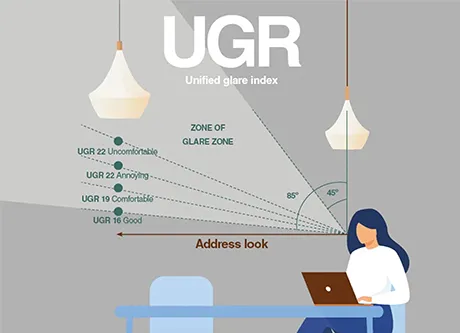
Unified Glare Rating (UGR) measures how much discomfort glare a luminaire produces. For automotive workshops, where technicians spend extended periods looking upward at vehicle undersides, controlling glare is critical for comfort and safety.
UGR < 19: Low glare, suitable for offices and areas with sustained visual tasks
UGR < 22: Acceptable for general industrial work
UGR 22–25: May cause discomfort for workers looking upward frequently
Choose luminaires with UGR < 22 for general workshop areas and UGR < 19 for inspection and detail work zones. Optical systems with asymmetric or batwing light distributions — such as those available in the Recolux E-line trunking system — provide excellent glare control while maintaining high illumination uniformity.
Lighting Design by Workshop Zone
A one-size-fits-all approach doesn't work for automotive workshops. Different zones have different visual tasks, environmental conditions, and lighting requirements. Here's how to approach each area.
General Repair & Service Bays
Requirements: 300–500 lux, CRI >80, IP54 minimum, CCT 4000K, UGR <22
General service bays handle routine maintenance — oil changes, brake inspections, tire rotations, and engine diagnostics. These tasks require adequate general illumination without excessive shadows. The key challenges are:
Shadow elimination: Vehicles create large shadow zones under the hood and beneath the chassis. Overhead lighting alone isn't sufficient; consider supplementary under-bonnet LED work lights for engine bay tasks.
Uniformity: Aim for a uniformity ratio (minimum/average illuminance) of at least 0.7 to avoid hot spots and dark zones.
Energy efficiency: Service bays may be occupied for 8–12 hours daily. High-efficacy LEDs (150+ lm/W) deliver significant energy savings over fluorescent or HID alternatives.
Recommended solutions: LED linear trunking systems (such as Recolux E-line with IP20 for dry areas, or N-line with IP54 where dust is present) provide continuous, uniform illumination across large bay areas. For individual bay lighting, LED batten luminaires offer a cost-effective solution.
Body Work & Surface Preparation
Requirements: 500–750 lux, CRI >90, IP54 minimum, CCT 5000K, UGR <19
Body work demands a significant step up in lighting quality. Technicians need to detect surface imperfections — scratches, dents, pinholes in filler, orange peel texture — that are invisible under lower-quality light. Critical considerations:
CRI 90+ is non-negotiable for surface inspection. Lower CRI light will mask color differences between filler and paint, hide sanding marks, and make it impossible to assess surface quality reliably.
Directional light for defect detection: Raking light (light at a low angle to the surface) reveals surface irregularities that diffuse overhead light misses. Consider luminaires with adjustable beam angles or supplementary inspection lights that can be positioned at oblique angles.
Flicker-free operation: LED drivers with high-quality flicker-free performance prevent eye strain during long surface inspection sessions and ensure accurate visual assessment.
Recommended solutions: High-CRI linear LED systems (Recolux E-line with Ra >90 optics) for overhead general illumination, supplemented with portable inspection lights for detail work. The E-line's multiple beam angle options (30°, 60°, 90°, 120°, asymmetric) allow you to tailor the light distribution to each bay's specific needs.
Paint Booths & Color Matching Areas
Requirements: 1,000 lux, CRI >90 (preferably CRI 95+), IP65, CCT 5000K–5500K, UGR <19
The paint booth is the most demanding environment in any automotive workshop. Getting the lighting wrong here is the most expensive mistake you can make, because every defect that goes undetected under inadequate light becomes a costly rework.
Lux level: 1,000 lux minimum per DIN EN 12464-1. Many high-end facilities specify 1,500+ lux for premium color matching work.
CRI and spectral quality: CRI 90 is the entry point; CRI 95+ is preferred for premium and custom paint work. Pay attention to the R9 value (the specific red rendering index) — many automotive paints contain red pigments that are poorly rendered by lights with low R9 scores even if the overall CRI appears acceptable.
Color temperature precision: 5000K–5500K is the standard for paint matching, as it most closely simulates the daylight conditions under which vehicle owners will assess the finished work. Deviations from this range introduce systematic color-matching errors.
IP65 for washability: Paint booth luminaires must withstand regular cleaning with solvents and water-based cleaning agents. IP65 protection ensures dust-tight seals and resistance to water jets.
Recommended solutions: IP65 tri-proof luminaires (Recolux E-evolution or E-plus) provide the protection level required for paint booth environments. Their selectable CCT feature allows you to switch between 4000K (for general booth work) and 5000K (for color matching and final inspection). The flicker-free operation ensures accurate visual assessment without fatigue.
Wash Bays & Detailing Areas
Requirements: 300–500 lux, CRI >80, IP65, CCT 4000K–5000K
Wash bays and detailing areas are wet environments where water, soap, and chemical agents are constantly present. Lighting must survive direct water exposure and chemical splashes while providing adequate illumination for thorough cleaning and inspection.
IP65 is essential. Lower IP ratings will allow moisture ingress that degrades the luminaire over time, leading to premature failure and potential electrical hazards.
Corrosion resistance: Chemical soaps, waxes, and cleaning agents can corrode luminaire housings. PC (polycarbonate) housings with IP65 sealing, as used in the Recolux E-evolution, provide excellent chemical resistance.
Sensor integration: Motion sensors add value in wash bays where technicians' hands are frequently occupied. The Recolux E-evolution's integrated microwave sensor option provides automatic on/off control that saves energy and adds convenience.
Recommended solutions: IP65 tri-proof luminaires with sensor options. The Recolux E-plus with its robust 5×2.5mm² cable connection and L1/L2/L3 phase-change grouping control is particularly well-suited for wash bay installations where multiple luminaires need to be controlled in groups.
Parts Storage & Warehouse
Requirements: 200–300 lux, CRI >80, IP20–IP54, CCT 4000K
Storage areas have the lowest lighting demands in the workshop, but that doesn't mean they should be neglected. Adequate illumination ensures that parts are correctly identified, picked, and stored — reducing errors and improving safety.
Efficiency first: With lower lux requirements, high-efficacy LEDs (150–180 lm/W) can deliver the required illumination at minimal energy cost.
Trunking systems for continuous rows: In large parts warehouses, linear trunking systems (Recolux E-line or N-line) provide continuous, seamless illumination along shelving aisles.
Smart controls: Occupancy sensors and daylight harvesting controls further reduce energy consumption in storage areas that are not continuously occupied.
Product Solutions for Automotive Workshop Lighting
Based on the requirements outlined above, here are the key Recolux product families and their recommended applications for automotive workshop environments:
E-line LED Trunking System — For Large Bay Illumination
The E-line trunking system is the workhorse for illuminating large, open workshop areas. Its modular design allows you to create continuous rows of light that provide uniform illumination across multiple service bays.
Optical versatility: Seven beam angle options (30°, 60°, 90°, 120°, 25° double, asymmetric-I) let you tailor the light distribution to each area's specific needs.
High CRI option: Ra >90 optics available — essential for body work and surface inspection areas.
Efficacy up to 180 lm/W: Delivers maximum illumination per watt, minimizing energy costs in spaces that are lit 8–16 hours per day.
Power switchable: Multiple wattage options in a single luminaire allow you to adjust light output to the task without changing fixtures.
Fast installation: Click-in trunking and snap-fit modules reduce installation time — critical for workshop retrofits where downtime costs money.
Best for: General repair bays, body work areas, parts warehouses — any large open area requiring uniform, high-quality illumination.
E-evolution Tri-proof Light — For Wet and Harsh Environments
The E-evolution is the premium choice for environments where water, dust, and chemicals are present. Its IP65 rating and PC housing make it ideal for wash bays, paint preparation areas, and any zone where the luminaire will be exposed to moisture or cleaning agents.
IP65 protection: Dust-tight and protected against water jets — suitable for wash bays and areas with regular wet cleaning.
CCT selectable & power switchable: Switch between color temperatures (e.g., 4000K for general work, 5000K for color matching) and adjust wattage to the task — one luminaire, multiple applications.
Tool-free maintenance: The extractable design with PC housing and aluminum heat sink allows PCB and driver replacement without tools. In a busy workshop, this means less downtime for maintenance.
Microwave sensor option: Automatic occupancy detection saves energy in intermittently used areas like wash bays and storage zones.
Emergency backup option: Ensures safe evacuation and continued operation during power outages — critical for workshops where vehicles may be on lifts or in paint booths.
Best for: Wash bays, paint booths, detailing areas, steam-cleaning zones — any area with moisture, dust, or chemical exposure.
E-plus Tri-proof Light — For Robust Group-Control Applications
The E-plus offers the same tri-proof protection (waterproof, dustproof, corrosion-proof) with added features for group control installations:
5×2.5mm² cables: Heavier-duty connections that resist vibration and pull-out — important in workshop environments where equipment may be bumped or jostled.
L1/L2/L3 phase change design: The simplest way to implement grouped lighting control, allowing different groups of luminaires to be switched independently without additional control wiring.
Dimming function: Integrated dimming capability for energy savings and task-specific light level adjustment.
Best for: Multi-bay workshops where different zones need independent control, wash bay rows, and installations requiring robust cabling.
LED Batten (Allnice / Aluminium Tubes / Steel Tubes) — For Budget-Friendly Bay Lighting
For smaller workshops or areas where IP65 protection isn't required, LED batten luminaires offer a cost-effective solution:
Allnice (IP44): Slim, flexible batten for dry indoor applications. Fastener end-cap design saves up to 80% on installation labor — ideal for quick retrofit projects in dry service bays.
Aluminium Tubes: Aluminum + PC construction with good heat dissipation and uniform illumination. Multilumen and multicolor options for different task requirements.
Steel Tubes: A practical replacement for existing T8/T5 tube installations, with simple retrofit compatibility.
Best for: Dry indoor service bays, offices, customer waiting areas, and retrofit projects on a budget.
Fluorescent to LED Retrofit: What Workshop Owners Need to Know
Many automotive workshops still operate with fluorescent tube lighting — T8 and T5 installations that are inefficient, prone to flicker, and expensive to maintain. Retrofitting to LED delivers immediate and substantial benefits.
Energy Savings
A typical 4-foot T8 fluorescent tube consumes 36W (plus ballast losses of 5–10W), while an equivalent LED batten or tube delivers the same or higher light output at 15–20W. For a workshop with 50 luminaires running 10 hours per day, this translates to:
Fluorescent: 50 × 40W × 10h × 365 days = 7,300 kWh/year
LED equivalent: 50 × 18W × 10h × 365 days = 3,285 kWh/year
Annual savings: ~4,015 kWh — a 55% reduction in lighting energy consumption
Maintenance Elimination
Fluorescent tubes have an average rated life of 10,000–15,000 hours and suffer from frequent ballast failures. In a busy workshop with 10-hour operating days, that means tube replacements every 2–3 years per fixture — plus the labor cost and disruption of each replacement. LED luminaires with 50,000+ hour rated lives eliminate this maintenance burden for a decade or more.
Light Quality Improvement
Standard fluorescent tubes typically deliver CRI 70–80 and color temperatures that shift as the tube ages. Replacing them with high-CRI LED luminaires provides an immediate and dramatic improvement in color accuracy — particularly valuable for body and paint operations.
Retrofit Options
Recolux offers multiple retrofit paths to match your existing infrastructure and budget:
Magnetic retrofit tubes (Mega / Meneo): The fastest path from fluorescent to LED. Magnetic mounting means no tools, no rewiring — snap out the old tube, snap in the LED replacement. Compatible with existing T8/T5 grille light fixtures in offices and inspection areas.
SuperFit retrofit luminaire: Designed for refurbishment of old trunking systems. Compatible with legacy trunking rails from major brands (Veko, Philips, Trilux, Zumtobel), allowing you to upgrade to LED without replacing the entire trunking infrastructure. Installation in under 44 seconds per unit.
Full system replacement: For new installations or major renovations, a complete LED trunking system (E-line or N-line) delivers the best long-term performance and efficiency.
Smart Lighting Controls for Automotive Workshops
Modern LED lighting systems can do much more than just turn on and off. Smart controls add significant value in workshop environments:
Occupancy Sensing
Microwave motion sensors detect presence in individual bays or zones. Lights automatically dim or turn off when a bay is unoccupied, and instantly return to full brightness when a technician enters. This is particularly effective in:
Wash bays that are used intermittently
Storage areas with low foot traffic
Inspection lanes used on a per-vehicle basis
The Recolux E-evolution and E-plus both offer integrated microwave sensor options, eliminating the need for separate sensor installations.
Daylight Harvesting
Workshops with skylights or large windows can benefit from daylight-responsive dimming. Sensors measure ambient natural light and automatically reduce artificial lighting output to maintain the target lux level. This can save an additional 20–40% on lighting energy in well-daylit spaces.
Group Control and Phase Switching
The E-plus's L1/L2/L3 phase-change design allows you to divide your workshop lighting into groups that can be controlled independently. For example:
Group A: General repair bays (full brightness during working hours)
Group B: Paint booth (activated only when the booth is in use)
Group C: Storage and low-traffic areas (motion-activated only)
This grouped approach ensures that each zone receives exactly the right amount of light at the right time — no waste, no compromise.
Emergency Lighting
Workshop safety regulations in most jurisdictions require emergency lighting that activates automatically during power failures. The E-evolution's emergency backup option ensures that critical escape routes remain illuminated and that technicians can safely lower vehicles from lifts and exit paint booths during outages.
Common Mistakes in Workshop Lighting Design
After decades of specifying lighting for industrial and automotive environments, these are the most frequent mistakes we see:
Mistake 1: Specifying Lux Without CRI
Meeting the lux requirement while ignoring CRI is the most common and most costly error in body shop lighting. A 1,000-lux installation with CRI 70 will not deliver acceptable paint matching results. Always specify both lux and CRI for any color-critical work area.
Mistake 2: Using the Same IP Rating Everywhere
Installing IP20 luminaires in a wash bay because they're cheaper is a false economy. They will fail prematurely, potentially creating electrical hazards. Conversely, specifying IP65 for a dry office area adds unnecessary cost. Match the IP rating to the actual environmental conditions of each zone.
Mistake 3: Ignoring Glare in Overhead Installations
High-output LED luminaires installed without proper optical control create intense glare — particularly problematic for technicians who work beneath vehicles on lifts. Always specify luminaires with appropriate UGR ratings and choose optical systems that control light distribution.
Mistake 4: Underestimating the Value of Uniformity
Point-source lighting (like bare high-bay fixtures) creates bright spots and deep shadows. In a workshop, shadows under vehicle chassis, behind engine blocks, and in wheel wells make work harder and slower. Linear lighting systems (trunking and batten) provide significantly better uniformity and shadow reduction than point-source alternatives.
Mistake 5: No Lighting Controls
Leaving all workshop lights at full brightness 8–16 hours per day, regardless of occupancy or daylight availability, wastes significant energy. Occupancy sensors, daylight sensors, and grouped switching pay for themselves within 1–2 years in most workshop environments.
Planning Your Workshop Lighting: A Step-by-Step Approach
Follow this structured approach to design a lighting system that meets your workshop's specific needs:
Map your zones: Divide your workshop into functional areas (general repair, body work, paint booth, wash bay, storage, office) and document each zone's dimensions, ceiling height, and environmental conditions.
Define requirements per zone: Using the specifications in this guide, assign target lux levels, CRI, CCT, IP rating, and UGR to each zone based on the visual tasks performed there.
Select luminaires: Choose product families that meet the specifications for each zone. Prioritize versatility — products like the E-evolution that offer CCT switching and sensor options can serve multiple zone types with a single SKU.
Plan the layout: Use lighting calculation software or consult with a lighting specialist to determine luminaire spacing, quantities, and mounting heights. Aim for uniformity ratios of 0.7 or higher.
Specify controls: Determine which zones benefit from occupancy sensors, daylight harvesting, or grouped switching. Include emergency lighting requirements.
Plan the installation: For retrofits, map the existing electrical infrastructure and identify the most efficient upgrade path (magnetic retrofit, trunking retrofit, or full replacement).
Verify compliance: Confirm that your design meets all applicable standards (DIN EN 12464-1, local workplace regulations, and any insurance requirements).
FAQ: Automotive Workshop LED Lighting
What CRI do I need for automotive paint work?
For reliable paint matching and color verification, you need a minimum CRI of 90. For premium and custom paint work, CRI 95+ is preferred. Also check the R9 value (red rendering index) — it should be 50 or higher for accurate rendering of red and warm-toned automotive paints.
What color temperature is best for a body shop?
5000K (daylight white) is the standard for body and paint shops because it closely simulates natural daylight conditions. This is the color temperature under which vehicle owners will assess the finished work, so it's essential that your paint matching and inspection happen under the same conditions.
Is IP65 necessary for automotive workshops?
IP65 is required for wash bays, steam cleaning areas, and any zone where luminaires will be exposed to water jets or frequent wet cleaning. For general repair bays in dry conditions, IP54 is the practical minimum. For offices and waiting areas, IP20 or IP44 may be sufficient.
How many lumens do I need per bay?
This depends on the bay size, ceiling height, and target lux level. As a general guideline for a standard 6m × 4m repair bay with 3–4m ceiling height, you'll need approximately 15,000–25,000 lumens for 300 lux, or 25,000–40,000 lumens for 500 lux. A professional lighting calculation based on your specific space dimensions is always recommended.
Can I retrofit my existing fluorescent trunking with LED?
Yes. The Recolux SuperFit retrofit luminaire is designed specifically for this purpose. It's compatible with legacy trunking rails from major brands and can be installed without tools in under 44 seconds per unit. For T8/T5 grille light fixtures in office areas, magnetic retrofit tubes (Mega / Meneo) provide an even simpler upgrade path.
What's the payback period for upgrading to LED workshop lighting?
For a typical automotive workshop operating 10+ hours per day, the energy savings alone typically deliver a payback period of 1.5–3 years. When you factor in maintenance elimination, reduced rework rates, and productivity improvements, the effective payback is often under 12 months.
Conclusion
Professional lighting is not a luxury for automotive workshops — it's a business investment that delivers measurable returns in quality, productivity, safety, and energy efficiency. By understanding the specific requirements of each zone in your workshop and selecting luminaires that meet those specifications, you can create a lighting environment that supports better work, fewer errors, and lower operating costs.
Whether you're building a new facility, expanding an existing one, or retrofitting outdated fluorescent lighting, Recolux offers a complete range of LED solutions designed for the demanding conditions of automotive workshop environments — from the high-CRI E-line trunking system for body work areas, to the IP65 E-evolution tri-proof light for wash bays and paint zones, to the budget-friendly LED batten range for dry service areas.
Ready to upgrade your workshop lighting? Contact the Recolux team for a free lighting consultation and custom layout recommendation tailored to your specific facility and requirements.
For more information about Recolux industrial lighting products, visit Recolux Industrial Lighting. To explore lighting solutions for specific applications, visit Recolux Applications.