LED Lighting Guidelines for Manufacturing and Storage Environments
Lighting is one of the most overlooked yet critical components in any industrial facility. In manufacturing plants, warehouses, assembly lines, and processing workshops, the quality of light directly influences worker safety, operational accuracy, and energy expenditure. A well-designed industrial LED lighting system does more than just illuminate — it creates an environment where people can work efficiently, machines can be operated safely, and operating costs can be kept under control.
In this guide, we will walk through the essential factors for selecting industrial LED fixtures, explain why IP65 protection matters in demanding environments, and show how Recolux lighting solutions help facilities worldwide achieve better illumination with lower total cost of ownership.
Why Industrial Lighting is a Strategic Investment, Not Just an Expense
For many facility managers, lighting is treated as a basic utility — something that just needs to work. But the data tells a different story. Research from the Illuminating Engineering Society and various occupational safety agencies consistently shows that proper industrial lighting can reduce workplace errors by up to 30% and decrease accident rates significantly.
Consider a typical manufacturing scenario: on a fast-moving production line, workers need to inspect components for defects, read gauge displays, and operate machinery with precision. If the lighting is uneven — with pools of brightness and shadows in between — fatigue sets in faster, mistakes increase, and throughput suffers. The cost of poor lighting is measured not just in the electricity bill, but in:
Reduced productivity — workers slow down when they cannot see clearly
Higher defect rates — quality control suffers under inadequate illumination
Safety incidents — tripping hazards, misread labels, and equipment mishandling
Increased absenteeism — eye strain and headaches from flickering or glaring lights
Switching to a properly designed LED industrial lighting system addresses all of these pain points while cutting energy consumption by 50-70% compared to fluorescent or HID alternatives. When you factor in the dramatically longer lifespan of LED fixtures (often 50,000+ hours), the return on investment typically materializes within 12 to 24 months.
The Hidden Cost of Outdated Industrial Lighting
Many facilities still rely on aging T8 or T5 fluorescent tube systems. These legacy setups come with recurring costs that are easy to overlook: frequent tube replacements, ballast failures, and the labor involved in maintenance. In a large warehouse with hundreds of fixtures mounted at heights of 6 to 12 meters, every maintenance visit requires specialized lifting equipment and scheduled downtime — costs that LED technology eliminates almost entirely.
Recolux E-line LED trunking systems, for example, are specifically designed as drop-in replacements for traditional fluorescent trunking: they reuse the existing mounting track, minimizing installation time and disruption. This makes the transition to LED not only energy-efficient but also remarkably practical.
Key Factors for Selecting Industrial LED Fixtures
Not all LED fixtures are suitable for industrial use. The harsh conditions found in factories, warehouses, and processing facilities demand lighting products that are built differently from commercial or residential fixtures. Here are the five critical criteria to evaluate:
1. Ingress Protection (IP) Rating
The IP rating indicates how well a fixture resists the entry of solid particles (first digit) and liquids (second digit). In industrial environments where dust, moisture, and occasional wash-downs are part of daily operations, an IP65 rating is the baseline standard to aim for. IP65 means the fixture is:
Dust-tight (6) — no ingress of dust whatsoever, even under active conditions
Protected against water jets (5) — can withstand low-pressure water jets from any direction
This level of protection ensures that your lighting investment survives in environments where airborne particles, humidity, and cleaning procedures would quickly degrade standard fixtures.
2. Light Output and Uniformity
Industrial spaces require consistent illumination levels, typically measured in lux. A warehouse aisle may need 150–200 lux, while a precision assembly area could require 500–750 lux. Beyond the raw lumen output, uniformity — the ratio of minimum to average illuminance across the space — is equally important. Uneven lighting creates visual discomfort and forces the human eye to constantly adapt between bright and dim zones.
Recolux linear fixtures like the Lidu21 series deliver luminous flux ranging from 9,450 to 22,850 lumens with selectable narrow, medium, and wide beam distributions, allowing lighting designers to achieve the right balance of intensity and coverage for any industrial layout.
3. Color Rendering Index (CRI)
CRI measures how accurately a light source reveals the true colors of objects compared to natural daylight. In industrial settings where color differentiation matters — think of wire color coding in electrical assembly, or distinguishing between material grades — a CRI of Ra > 80 is recommended, and Ra > 90 is preferred for quality-critical tasks. Recolux E-line systems achieve Ra > 90, ensuring that operators see every color as it truly is.
4. Glare Control
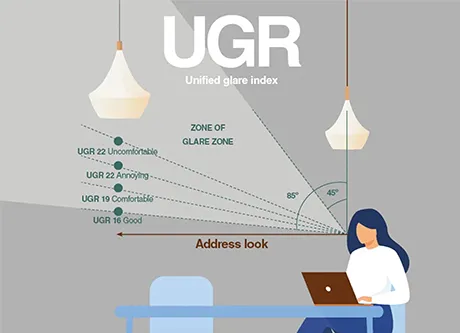
Glare is more than an annoyance; it is a safety hazard. Direct glare from overly bright fixtures can momentarily blind workers operating forklifts or heavy machinery. The Unified Glare Rating (UGR) should be kept below 22 for most industrial applications. Recolux fixtures incorporate optical designs with 20 distinct lens and reflector combinations, allowing precise glare management tailored to each installation height and task requirement.
5. Durability and Maintenance Accessibility
Industrial fixtures must withstand vibration, temperature fluctuations, and physical impact. The housing material matters: polycarbonate (PC) enclosures offer impact resistance, while aluminum frames provide excellent heat dissipation. Furthermore, fixtures should be designed for easy maintenance — the E-evolution tri-proof light, for instance, features a pull-out design that allows PCB and driver replacement without removing the entire housing from the ceiling.
IP65 Protection: Essential for Dusty and Wet Industrial Environments
Among all the specifications on a fixture datasheet, the IP rating often receives less attention than lumens or wattage — but in industrial applications, it can be the difference between a lighting system that lasts a decade and one that fails within months.
Let us look at the environments where IP65-rated fixtures are non-negotiable:
| Environment | Primary Challenge | Why IP65 Matters |
|---|---|---|
| Food processing plants | Regular wash-downs, humidity, airborne particles | Water jets during cleaning will not penetrate the fixture |
| Woodworking & carpentry workshops | Fine sawdust accumulation | Dust-tight seal prevents internal buildup that causes overheating |
| Metal fabrication & welding bays | Metal dust, cutting fluid mist | Complete protection against conductive particulate ingress |
| Textile & garment factories | Fabric fibers suspended in air | Prevents flammable fiber accumulation inside the housing |
| Cold storage & refrigerated warehouses | Condensation, temperature swings | Sealed construction prevents moisture ingress during defrost cycles |
| Underground parking & car workshops | Vehicle exhaust residue, humidity | Resistant to corrosive particulate and occasional water exposure |
| Agricultural processing facilities | Dust, ammonia, high humidity | Complete dust seal and water resistance ensure reliable operation |
Recolux tri-proof lights — the E-evolution, E-plus, and E-open series — are purpose-built for these demanding conditions. They combine IP65 dust and water protection with robust polycarbonate housings and efficient aluminum heat sinks, creating fixtures that thrive where standard luminaires fail.
Pro Tip: When specifying IP65 fixtures for your facility, also consider the IK rating (impact protection). In environments with moving equipment, forklifts, or potential for accidental collisions, a higher IK rating adds an extra layer of physical durability that IP ratings alone do not cover.
Lighting Design Principles for Different Industrial Spaces
Each zone within an industrial facility has distinct lighting requirements. A one-size-fits-all approach leads to over-lit areas wasting energy and under-lit areas compromising safety. Here is how to approach the most common industrial spaces:
High-Bay Warehouses and Logistics Centers
Warehouses with ceiling heights of 6 to 15 meters need fixtures with narrow to medium beam angles to deliver sufficient light to the floor and rack faces. The goal is to achieve 150–300 lux in aisles and picking zones, with good vertical illumination on shelving so that labels and barcodes are readable. Linear fixtures arranged in continuous runs along the aisles typically provide better uniformity than point-source high-bay fixtures.
Recolux Lidu21 linear fixtures, with their adjustable lumen output (9,450–22,850 lm) and selectable beam distributions, allow warehouse designers to fine-tune the lighting layout for optimal coverage without wasting energy on over-illumination.
Production Lines and Assembly Areas
On production and assembly lines, the priority shifts to task visibility and color accuracy. Workers need to see fine details, distinguish between similar components, and identify defects quickly. Recommended illuminance levels range from 300 lux for basic assembly to 750+ lux for precision work. CRI should be Ra > 80 at minimum, with Ra > 90 strongly preferred.
The E-line LED trunking system excels here: with 20 optical combinations and exceptional glare control, it can be configured for any production environment. Its continuous linear form factor eliminates the dark spots that occur between separately mounted fixtures, creating a seamless ribbon of light along the entire line.
Automotive Workshops and Repair Bays
Vehicle service areas combine several challenges: the need for bright, shadow-free illumination under vehicles; resistance to oil mist and exhaust residue; and an aesthetic that reflects professionalism. Tri-proof fixtures like the E-open, with its innovative snap-open design for quick cable access on either side, make installation and maintenance straightforward even in workshops with limited ceiling access.
Cold Storage and Temperature-Controlled Facilities
Cold storage environments present a unique challenge: LED fixtures must start reliably at low temperatures (sometimes as low as −30°C) and withstand condensation when defrost cycles run. IP65-rated fixtures with sealed construction prevent moisture from entering the housing during these thermal cycles, ensuring consistent performance year-round.
Recolux Industrial Lighting Products for Every Application
Recolux offers a comprehensive range of industrial LED lighting solutions, each engineered for specific installation scenarios and performance requirements. Below is an overview of the key product lines and where they fit best:
| Product Series | Type | Best For | Key Advantages |
|---|---|---|---|
| E-line | Trunking System | Production lines, assembly areas, warehouses | Ra > 90, 20 optical combinations, continuous linear design, intelligent control |
| E-evolution | Tri-proof Light (IP65) | Food processing, woodworking, textile, cold storage | Pull-out design for easy maintenance, CCT & power switchable, emergency backup, sensor-ready |
| E-plus | Tri-proof Light (IP65) | Wet and dusty workshops, parking garages, agricultural facilities | 5×2.5mm² cable, L1/L2/L3 phase switching for group control, dimmable, energy-saving |
| E-open | Tri-proof Light (IP65) | Automotive workshops, retrofit projects, quick-install scenarios | Open snap-fit design, dual-side cable entry, minimal installation time |
| Lidu21 | Linear Fixture | High-bay warehouses, sports facilities, large industrial halls | 9,450–22,850 lm, selectable beam angles, high efficiency |
| N-line | Trunking System | Dusty industrial environments, workshops | Dust-proof design, reliable continuous lighting |
All Recolux tri-proof and trunking fixtures are designed with modularity and ease of installation at their core. Most components use snap-fit, plug-in, or integrated locking mechanisms that dramatically reduce on-site labor. For retrofit projects where existing fluorescent trunking is already in place, Recolux lighting systems can often reuse the original mounting track, eliminating the need for structural modifications and minimizing disruption to ongoing operations.
Energy Efficiency and Long-Term ROI of Industrial LED Lighting
Let us talk numbers. For a mid-sized manufacturing facility with 500 lighting fixtures operating 16 hours per day, 300 days per year, the financial comparison between legacy fluorescent and modern LED is compelling:
| Metric | Fluorescent (2×58W T8) | LED Equivalent (50W) | Annual Saving |
|---|---|---|---|
| Power per fixture | ~130W (incl. ballast) | 50W | — |
| Annual energy (500 fixtures) | 312,000 kWh | 120,000 kWh | 192,000 kWh |
| Annual electricity cost (at €0.15/kWh) | €46,800 | €18,000 | €28,800 |
| Tube replacement (annual) | ~200 tubes | ~0 | Material + labor saved |
| Typical lifespan | 8,000–12,000 hours | 50,000+ hours | 5× longer service life |
Beyond direct energy savings, LED industrial lighting reduces HVAC load because LEDs generate significantly less heat than fluorescent or HID lamps. In air-conditioned facilities, this secondary cooling saving can add another 10–15% to the total energy reduction.
When you include the elimination of lamp replacement labor, reduced downtime for maintenance, and improved worker productivity from better lighting quality, the total cost of ownership advantage of a well-designed LED system over legacy technology typically exceeds 60% over a 5-year period.
Steps to Plan Your Industrial Lighting Upgrade
If you are considering upgrading your facility's lighting, here is a practical roadmap to get started:
Audit your current installation — document the number of fixtures, their types, wattages, mounting heights, and spacing. Note any areas with known issues (flickering, dark spots, frequent failures).
Define lighting requirements by zone — map out the target lux levels for each area based on the tasks performed. Reference standards such as EN 12464-1 for indoor workplace lighting.
Identify environmental challenges — assess dust levels, humidity, temperature extremes, vibration, and cleaning procedures that will affect fixture selection.
Evaluate control opportunities — daylight harvesting near windows and skylights, occupancy sensing in low-traffic areas, and scheduled dimming can add 20–40% additional energy savings on top of the LED upgrade itself.
Request a professional lighting design — a photometric simulation using DIALux or similar software will validate that your chosen fixtures and layout achieve the required uniformity and lux levels before any equipment is purchased.
Get a Free Lighting Consultation for Your Facility
Every industrial facility is different. Tell us about your space, and our lighting engineers will prepare a customized proposal — including photometric simulations, product recommendations, and a detailed ROI calculation — at no cost.
Request Your Free Consultation →
Or email us directly: info@recolux-led.com | Call: +86-755-8217-6296
Frequently Asked Questions About Industrial LED Lighting
Q: What is the difference between IP65 and lower IP ratings?
IP65 means the fixture is completely dust-tight and protected against water jets. Lower ratings like IP44 or IP54 offer only partial dust protection and limited water resistance, making them unsuitable for wet or dusty industrial environments where long-term reliability is required.
Q: How long do industrial LED fixtures last?
Quality industrial LED fixtures from Recolux are rated for 50,000+ hours of operation (L70 standard, meaning lumen output remains above 70% of the initial value at that point). In a typical 16-hour-per-day operation, this translates to roughly 8–10 years before any noticeable degradation occurs.
Q: Can LED fixtures replace my existing fluorescent tubes directly?
Yes. Recolux trunking systems are specifically designed for retrofit compatibility, often reusing the original mounting track and requiring only the wiring components to be updated. This approach dramatically reduces installation time and structural modifications compared to a full tear-out and replacement.
Q: Do Recolux products support smart controls and dimming?
Absolutely. The E-line, E-plus, and E-evolution series all support sensor integration (motion and daylight), dimming protocols, and intelligent control systems. This allows facilities to implement automated lighting schedules, occupancy-based control, and daylight-responsive dimming for maximum energy efficiency.